Mobile Industrial Robots
Discover what your industrial robot project can achieve when you partner with us. We look forward to hearing from you – and to learning more about your design. Dual-arm robots are composed of two arms that can work together on a given work piece. But while 6-axis robots can only have one posture for one given tool position, redundant robots https://columbiaokura.com/products/industrial-robots/ can accommodate a given tool position under different postures. This is just like the human arm that can hold a fixed handle while moving the shoulder and elbow joints. With more than 20,000 painting robots installed worldwide, ABB’s decades of experience have culminated in PC software designed with the customer’s needs in mind. Get even more accurate search results via payload analyses with KUKA Compose.
Robots are also not reliant on heavy bases to keep them stable - they are bolted to the floor, wall, or gantry, often via a baseplate, raft or other metalwork. A stabilizer support provides positional control to the link, allowing it to move in a predetermined path. Each bearing is prelubricated or provided with a lubrication line or fitting. The link contains a position sensor which provides another position signal to the controller.
The free software offers extra search filters as well as the option of comparing up to three industrial robots simultaneously to find the ideal robot model for your requirements. FANUC's FIELD system Zero Down Time application is designed to eliminate down time and enhance overall robot performance. While FANUC robots are highly reliable, manufacturers still need a solution to maximize uptime. Wikimedia Commons has media related to Industrial robots.Industrial robots and robot system safety - The teach pendant or PC is usually disconnected after programming and the industrial robot then runs on the program that has been installed in its controller. However a computer is often used to 'supervise' the industrial robot and any peripherals, or to provide additional storage for access to numerous complex paths and routines. Drive – some industrial robots connect electric motors to the joints via gears; others connect the motor to the joint directly.
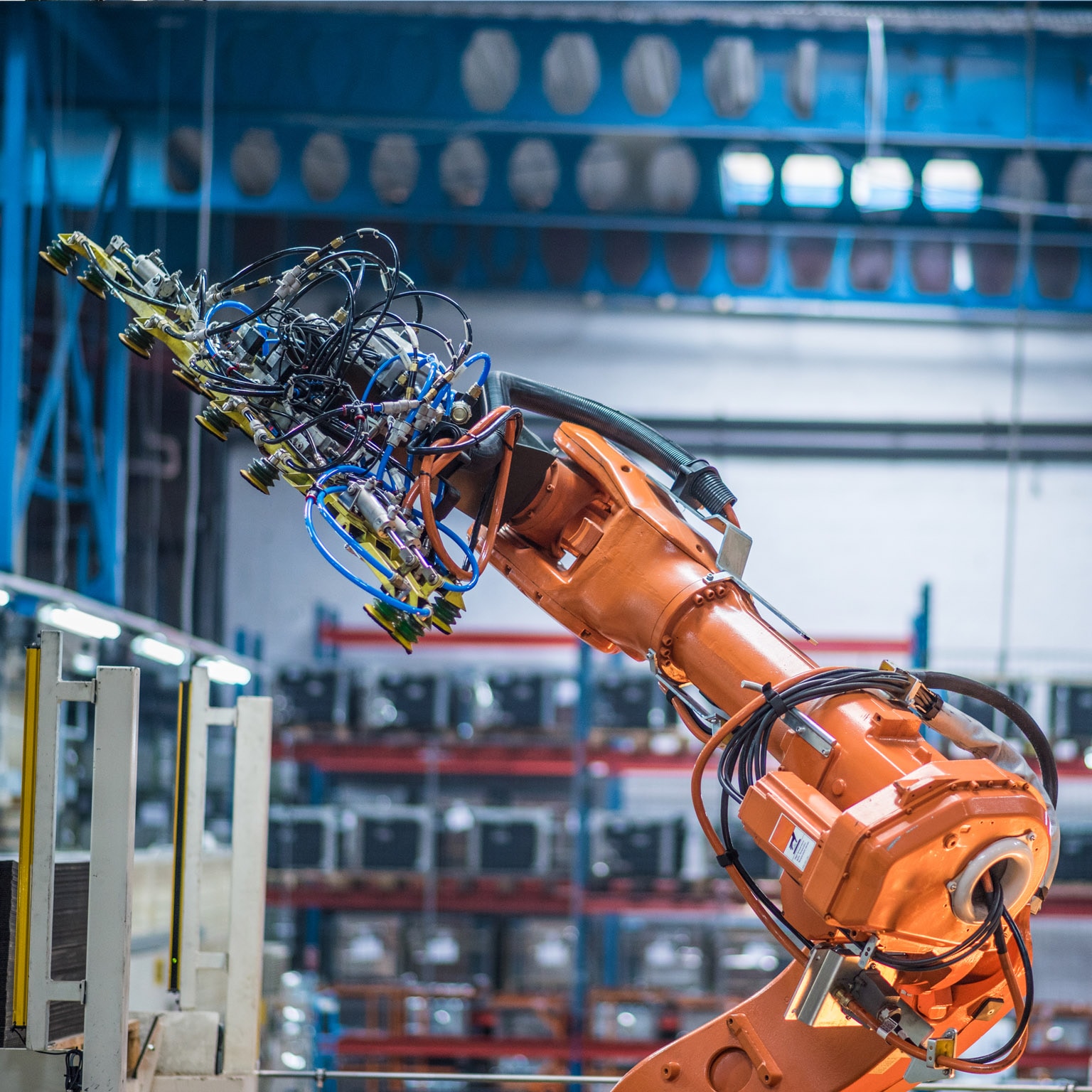
The Top 5 Industries Which Use Industrial Robots
Using gears results in measurable 'backlash' which is free movement in an axis. Smaller robot arms frequently employ high speed, low torque DC motors, which generally require high gearing ratios; this has the disadvantage of backlash.
Sage 300 CRE Most widely-used construction management software in the industry. ABB, FANUC CORPORATION, and KUKA AG are the top companies in the global market.
Within robot type, the articulated segment is expected to lead the market share during the forecast period. The cutting and processing segment is expected to show considerable growth in the coming years with the increasing trend of customization of cars, rising focus of precision cutting across various applications, and others. Assembling, welding & soldering and pick and place application is expected to surge a considerable growth in the forecast period. Growth is likely to be driven by a rise in automotive, metal machinery, electrical and electronic industry where customized spare parts are assembled and installed in the finished product. Based on the robot type, the market is segmented into articulated, SCARA, cylindrical, cartesian/linear, parallel, and others. Please complete this reCAPTCHA to demonstrate that it's you making the requests and not a robot.
For more information contact JHFoster at 800.582.5162 ore-mailus to learn more about how you might benefit from knowing us. Dedicated robots designed to meet the specific needs of every industry from cleanrooms to harsh environments. Finally, robots do not require the same space as humans, meaning manufacturers can better utilize their floor space to fit additional inventory or production lines. For example, wide aisleways initially intended for human navigation can be condensed to allow for the minimum required clearance for a robot to navigate. In many automotive plants, robots are assembling smaller components like pumps and motors at high speeds. Often, robots are performing tasks like windshield installation and wheel mounting to increase throughput.
Number of axes – two axes are required to reach any point in a plane; three axes are required to reach any point in space. To fully control the orientation of the end of the arm(i.e. the wrist) three more axes are required. Some designs (e.g. the SCARA robot) trade limitations in motion possibilities for cost, speed, and accuracy. These tools are designed for safety around human worker and to be easy to program through the robot’s teach pendant. They’re cost-effective, highly flexible, and easy to change for different processes to support fast ROI and quick results.
Industrial Robotic Systems
Collaborative robots are generally thought to be safer because they move more slowly, so it would be interesting to see if speed becomes a differentiating factor in this market. The Brabo is said to be the first Indian-made industrial robot and is aimed at the automotive trade. But its collaborative quality will probably make it an attractive purchase for outside companies if Bosch were to market it to others. And the robotics division seems to have a lot of potential in the shipbuilding sector. Hanwha says its collaborative robot is the first of its kind in South Korea and the company plans to use it in its own operations. With many new technologies, like collaborative robots, one of the main challenges is explaining how it can be used. The company’s innovative machines offered many new things, mainly the opportunity to use smaller, less expensive robots, and use them in a variety of settings without the need for cages to separate them from human workers.
Seiko lists industrial robots in its “precision products” category, and is looking to grow the division going forward, with plans to launch collaborative robots in the future. The company is the latest to announce that it will be launching a collaborative robot model. While it may have been controversial from some people’s point of view, Midea’s acquisition of Kuka places the industrial robot maker in the ideal position to make the most of the growing market for robots in China and Asia. Like many of these large industrial robot makers, Nachi-Fujikoshi has historic roots going back around a century. Kawasaki says it is planning to expand its robot production to include more collaborative models.
Collaborative robots are generally thought of as small, but Comau believes there is a gap in the market for a cobot with a significantly larger payload. Foxconn is probably unlikely to sell its robots to outside companies any time soon as it’s struggling to keep up with Apple iPhone orders. Some of its factories have very few humans in them, and as industrial robots become more suited to electronics manufacturing, Foxconn is likely to establish even more fully automated facilities. Stäubli has launched a new collaborative industrial robot and is investing more into its software business.
The company has seen tremendous success with its new collaborative industrial robot, the duAro, of which it has sold 2,000 units in China. Kawasaki is probably best known for being a builder of motor bikes, but it is also one of the biggest manufacturers of robotics equipment in the world. The company has also launched new types of robots, including the eye-catching two-armed YuMi robot. Ability is ABB’s network for connecting its robots and other equipment to enable precise monitoring and control, and is probably one of the most complete solutions of its type. In terms of hardware, there is the possibility of integrating more computing capabilities inside the robotic arm itself, and using more efficient actuators and other components. The cost savings of leveraging robotic technology can be potentially dramatic. We offer anROI Robotic System Value Calculatorso you can see firsthand the increased efficiencies robotic technology could provide you with.
If you are having trouble seeing or completing this challenge, this page may help. Just to say that hydralics have not been used to power robots for several years now. Gas springs are sometimes used to balance a robots mechanical system but motive force is supplied by brushless AC servomotors in almost every robot.
These collaborative industrial robots are built to work together with other robots, on enormous assembly lines. Robots must collaborate between handling and welding industrial robots to make such assembly lines function properly.

Комментарии
Отправить комментарий